
Compute Trading
Powered by Polymarket

Many have called compute the new oil. As oil and fossil fuels powered the industrial revolution, compute is powering the AI one. Like oil prices though, compute is volatile and has become a material variable cost in the AI ecosystem. Right now, as we have seen in markets that are building out this ecosystem, there is a mad dash for compute.
A few recent headlines:
Blackwell GPU rentals up 48% in two months, hyperscalers locked out of Nvidia's allocation. GPU rental prices for Nvidia's Blackwell chips hit $4.08 per hour, up 48% from $2.75 two months earlier. OpenAI CFO Sarah Friar said publicly: "We're making some very tough trades at the moment on things we're not pursuing because we don't have enough compute." (Wall Street Journal)
Microsoft, Google, Meta, and Amazon placed multi-billion-dollar forward orders for Blackwell GPUs that consumed most of Nvidia's allocation through 2027, crowding out mid-market customers entirely. The bottleneck has shifted upstream to High Bandwidth Memory. (Vexxhost / GPUnex)
"Microsoft expects to stay capacity constrained through 2026" Microsoft CFO Amy Hood said on the earnings call that even with capex above $40 billion in the quarter, the company expects to stay capacity constrained through 2026. Alphabet raised 2026 capex guidance to $180-190 billion and signaled 2027 will be "significantly" higher. Combined hyperscaler capex for 2026 is tracking $660-690 billion — nearly double 2025. (Fortune)
This chart below is the Ornn H100 compute index and it shows the extent of the recent rise in demand for compute. The Ornn Compute H100 Price Index tracks the spot price of NVIDIA H100 rate. It has gone parabolic in recent weeks.
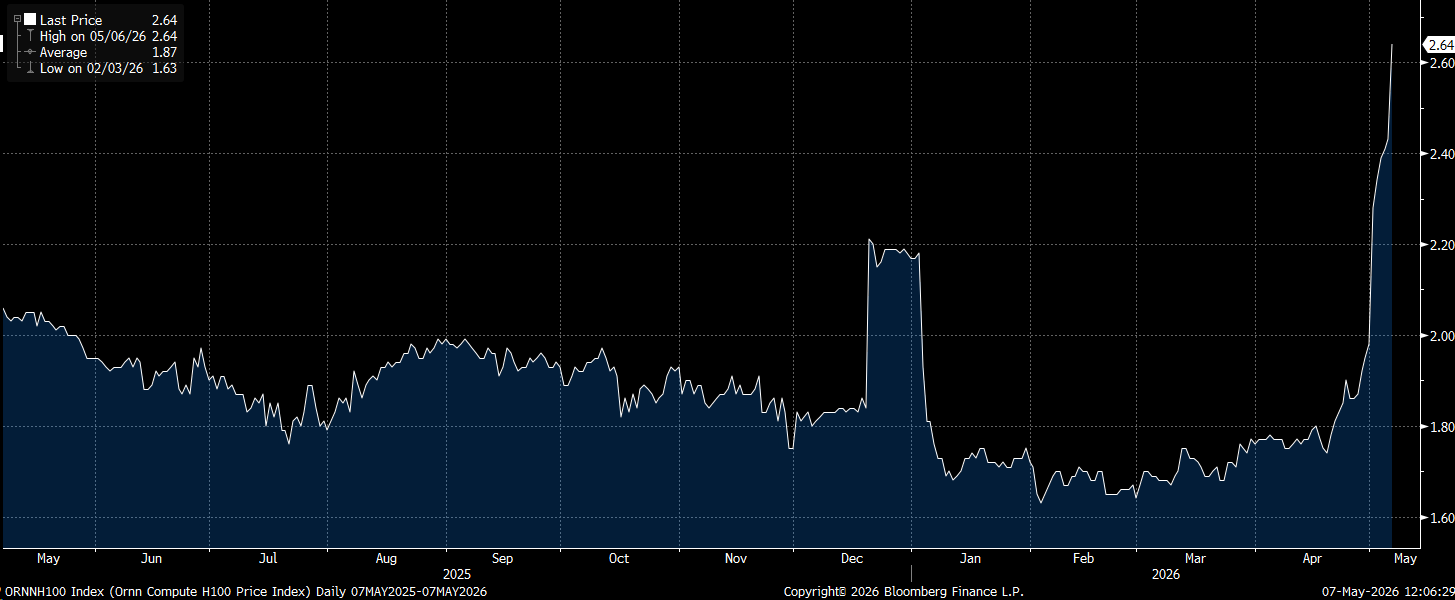
This is why we are seeing absolutely mind boggling numbers in terms of capex from the hyperscalers. As of their Q1 earnings, the hyperscalers said they were planning on doing over $700b of capex this year, which in context, is 2.5% of US GDP. Looking at other capex cycles in recent decades, such as shale, and the internet with telecom/fiber, none of these capex cycles were as big as the AI capex cycle is as a % of US GDP.
The point is, part of the reason AI capex continues surging is that the ecosystem is short of compute as evidenced by the recent surges in GPU rental rates. However, compute in of itself is not really a traded asset, and given its importance within the AI ecosystem and thus the economy, it seems like it really should be.
There are a lot of people that are trying to solve this, but it seems like between futures contracts and prediction markets there is a natural place for compute to be traded. The question is, how does this actually work practically because while it is nice to say that compute is the new oil, functionally they are very different commodities. Oil is storable and compute is not. With that said, we do have markets for things that are not storable, electricity is something that comes to mind here.
Electricity trading is a similar comparison to what compute trading looks like. Electricity futures work by letting the buyer and seller agree to a price for power to be delivered in a future window. Electricity, like compute, cannot be stored, so it is a very different settlement mechanism than say commodities like oil and agriculture, which have a storage component and are actually settled via delivery. The settlement mechanism for electricity futures is in cash against a published spot price index, which is typically location dependent (PJM Western Hub, ERCOT North, Mid-C, NYISO Zone J etc.). Compute is about to inherit the same architecture: GPU-hour indices in place of power hubs, but the same basic mechanics of locking in price today and settling in cash later.
The need is quite obvious for compute trading. The money in this space is truly massive. Data centers are multi-billion dollar projects, training runs are hundreds of millions dollars, to have this much variable cost for something that is very volatile in pricing such as compute, at the scale of these projects has created a real need for a market for this “commodity.”
From a trading perspective, this is pretty exciting. We can now trade the heartbeat of the global economy like the commodity that it effectively is.
A few interesting potential examples that come to mind:
Labs can buy compute contracts to lock in their training runs.
Data center investors can hedge as cash flows are so tied to GPU rental rates.
Arbitrage opportunities between things like H100s and H200s pricing. Similar to how the WTI/Brent basis is traded in oil futures.
Within prediction markets, there will be relative value trades to do. For example, if Polymarket is pricing in a new model release over the next few weeks and compute is trading somewhat soft going into that, that could be an interesting relative value trade.
From the models to the data centers, to the capex cycle, to the chips maker, the underlying dynamic of this AI cycle is compute and being able to trade that dynamic directly in terms of speculation or hedging is an exciting new market. This market is very new and will have to go through its growing pains and there are issues that will have to be worked out. With that said, it seems like a really exciting market and on the institutional side, Polymarket is already facilitating institutional sized trades in compute. If you would like to hear more about that, please reach out to me at the email below.
Of course in general, there are already GPU offerings on Polymarket that should continue to grow in liquidity.
Overall: There are a lot of players that have broken into the space of trading compute, and given the importance of this commodity, it makes sense for this market to expand in terms of both scope and players involved. So much of markets right now are implicitly a function of compute availability, as it is the power of the AI trade. Being able to trade and hedge that factor at the source is a really interesting evolving market and I think Polymarket is offering a good institutional approach to doing so.
To signup on Polymarket feel free to use this link.
If you are an institution that is interested in getting set up on Polymarket please reach out at info@jstadvisors.com
DISCLAIMER: The content published on Cheap Convexity is for informational and educational purposes only. Nothing here constitutes investment advice, a solicitation, or a recommendation to buy or sell any security, financial instrument, or prediction market contract. The views expressed are analytical in nature and should not be relied upon as the basis for any investment decision.